
Why a Random Train-Test Split Destroys Your Time-Series AI
Randomly splitting time-series datasets introduces temporal data leakage, making models look highly accurate in testing while failing completely in production.

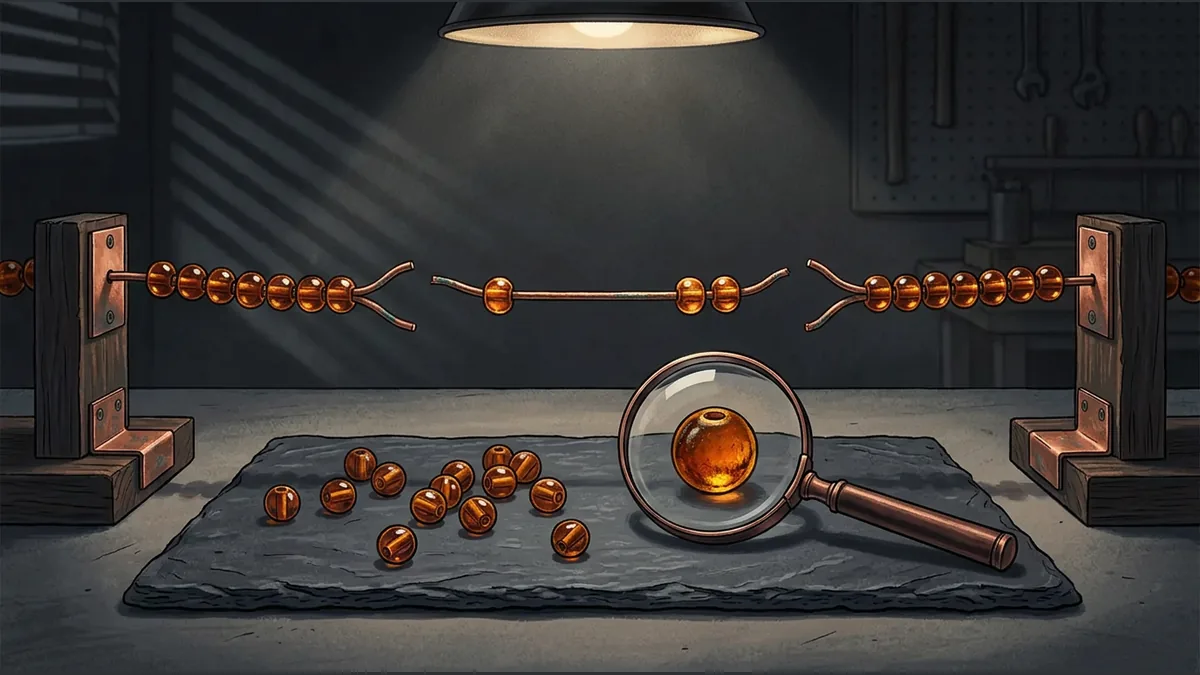

In standard machine learning workflows, randomly splitting a dataset into training and testing subsets is a default step. However, applying this random shuffle to time-series data introduces a severe flaw known as temporal data leakage. Instead of learning to forecast future events, the model learns to cheat by looking at future data points that have been shuffled into its training set.
How Shuffling Creates an Evaluation Trap
When you randomly shuffle time-dependent data, you break the chronological order of the observations. The model ends up training on data points that occur both before and after the points in the test set. Consequently, during evaluation, the model does not actually predict the future. Instead, it interpolates between closely adjacent past and future data points that it has already seen during its training phase. This leads to artificially high performance metrics that vanish once the model is deployed.
A Hypothetical Wind Turbine Scenario
Imagine building an AI to predict wind turbine bearing failures using continuous temperature readings. If you randomly split the 10,000-minute log, the training set might contain minutes 141 and 143, while the test set contains minute 142. Because physical temperatures cannot change instantly, the model easily guesses the temperature of minute 142 by interpolating between its neighbors. It scores 99% accuracy in testing. However, when deployed in the field, it cannot look ahead to minute 143, and its predictive power collapses.
The Challenge of Non-Stationary Datasets
The core issue deepens when dealing with non-stationary datasets. A stationary dataset is defined as one that does not undergo significant changes over time. However, real-world time-series data is rarely stationary. When data is non-stationary, such as changing human preferences, models trained on historical data struggle to make accurate predictions about future years.
To evaluate a model realistically under these conditions, the training and testing partitions must reflect the chronological flow of time. Sorting data from earliest to most recent makes dataset partitions less statistically similar if the underlying dataset is non-stationary. This dissimilarity is crucial because it forces the model to prove it can generalize to unfamiliar future patterns rather than relying on historical similarities.
Strategies for Valid Time-Series Evaluation
- Chronological Splitting: Always partition your data by a specific cutoff date, training on the past and testing on the future.
- Time-Series Cross-Validation: Use a rolling origin approach where successive training windows are used to predict subsequent periods.
- Feature Engineering Constraints: Ensure that lag features only use information available prior to the prediction target.
Key Takeaway for Developers
To build reliable time-series AI, you must respect the arrow of time. Avoid random splits entirely and implement strict chronological partitioning. This ensures your evaluation metrics reflect real-world performance, saving you from deploying models that fail when facing the actual, unfolding future.
Your reaction
Loading reactions…


Comments 0
Review comments