
Why Your CPU Throttles Before Your Cooling Fans Even Start to Spin
Modern processors adjust clock speeds and voltages in milliseconds, causing localized silicon temperatures to spike to thermal limits long before physical cooling systems can react.

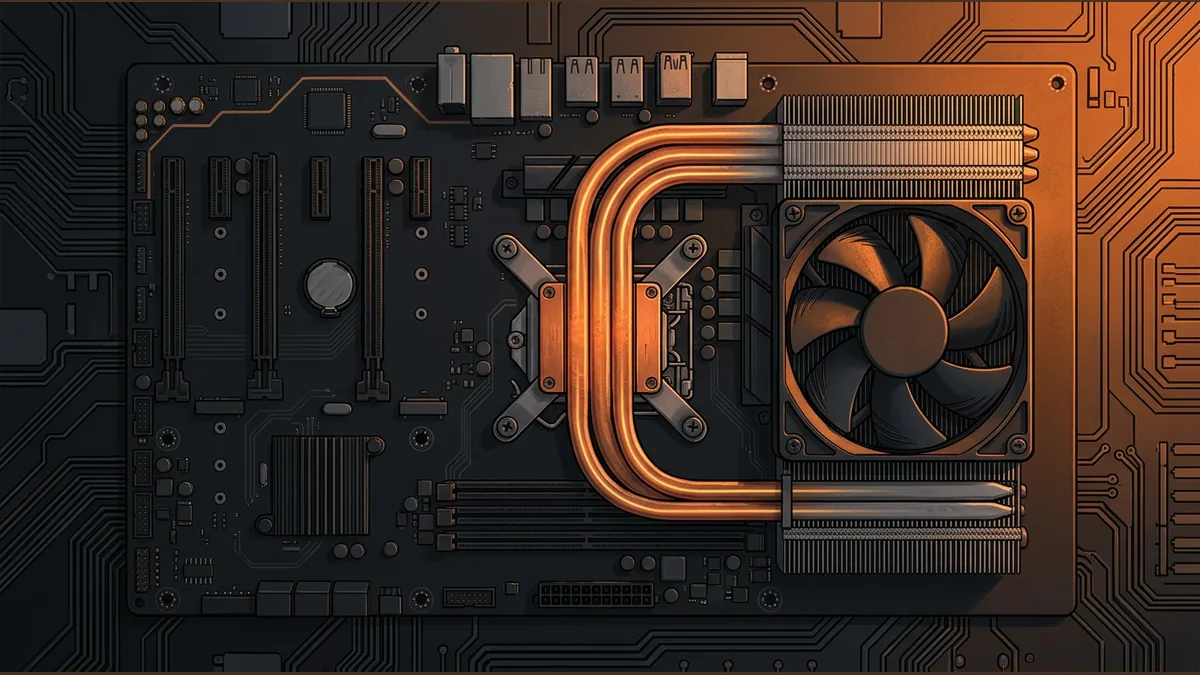

When you launch a demanding application, your computer's processor often reaches its thermal limits and begins throttling before you hear the cooling fans speed up. This behavior can seem like a hardware failure, but it is actually a normal consequence of how modern silicon manages power. While physical cooling systems rely on mechanical fans that take seconds to spin up, processors adjust their performance states in a fraction of a millisecond, causing localized heat to spike almost instantly.
How Processors Shift Performance States
Modern processors do not run at a single static speed. Instead, they operate across multiple clock frequency and voltage configurations known as Operating Performance Points, or P-states. To match workload demands, the operating system scheduler triggers utilization update callbacks during events like task changes or scheduler ticks. These callbacks compute the necessary performance scaling changes and instruct the hardware to switch states. Because the transition latency required to switch a CPU between these performance states is measured in nanoseconds, the processor can ramp up its power consumption almost instantaneously.
The Millisecond Feedback Loop
Once the hardware adjusts its performance state, it monitors its own behavior with extreme precision. Hardware-provided feedback on average CPU frequency is reported on a very short time frame spanning at most a few milliseconds. This rapid feedback loop allows the processor to continuously evaluate its thermal and power headroom. If a heavy workload suddenly saturates the silicon, the temperature at the microscopic transistor level rises faster than heat can physically conduct through the silicon die, the integrated heat spreader, the thermal paste, and the metal heatsink.
A Hypothetical Burst Workload
Consider a hypothetical high-performance database server processing a sudden, massive batch of complex queries. Within 5 milliseconds of receiving the request, the CPU cores spike to 100% utilization and hit their 95°C thermal limit, triggering immediate clock-speed throttling to protect the silicon. Meanwhile, the server's chassis fans, bound by physical inertia and a built-in 2-second sensor polling interval, remain at a quiet 1,200 RPM. The fans only scream to life long after the CPU has already throttled and completed the short burst of work.
Why Physical Cooling Systems Lag Behind
This lag between silicon heating and fan acceleration is due to fundamental physical limitations. While the digital scheduler can make decisions and execute state transitions in nanoseconds, physical cooling components must obey the laws of thermodynamics and mechanics:
- Thermal mass requires time for heat to migrate from the silicon die to the radiator fins.
- Temperature sensors on the motherboard or fan controllers use polling intervals that introduce a delay.
- Fan motors require physical time to overcome inertia and ramp up to higher rotational speeds.
The Takeaway for System Builders
Short-burst thermal throttling is an expected design behavior of modern opportunistic boost algorithms, rather than a system failure. Understanding this delay helps system builders realize that immediate temperature spikes are normal. Instead of worrying about brief thermal peaks, users should focus on sustained workloads where the cooling fans have had adequate time to spin up and establish a stable thermal equilibrium.
Your reaction
Loading reactions…


Comments 0
Review comments