
Why an Offline App Can Save the Wrong Version of a Record Without Failing
Offline sync can succeed technically while still applying a local edit to a record that changed on the server. The risk is not failed upload, but an unnoticed conflict that rewrites newer data.

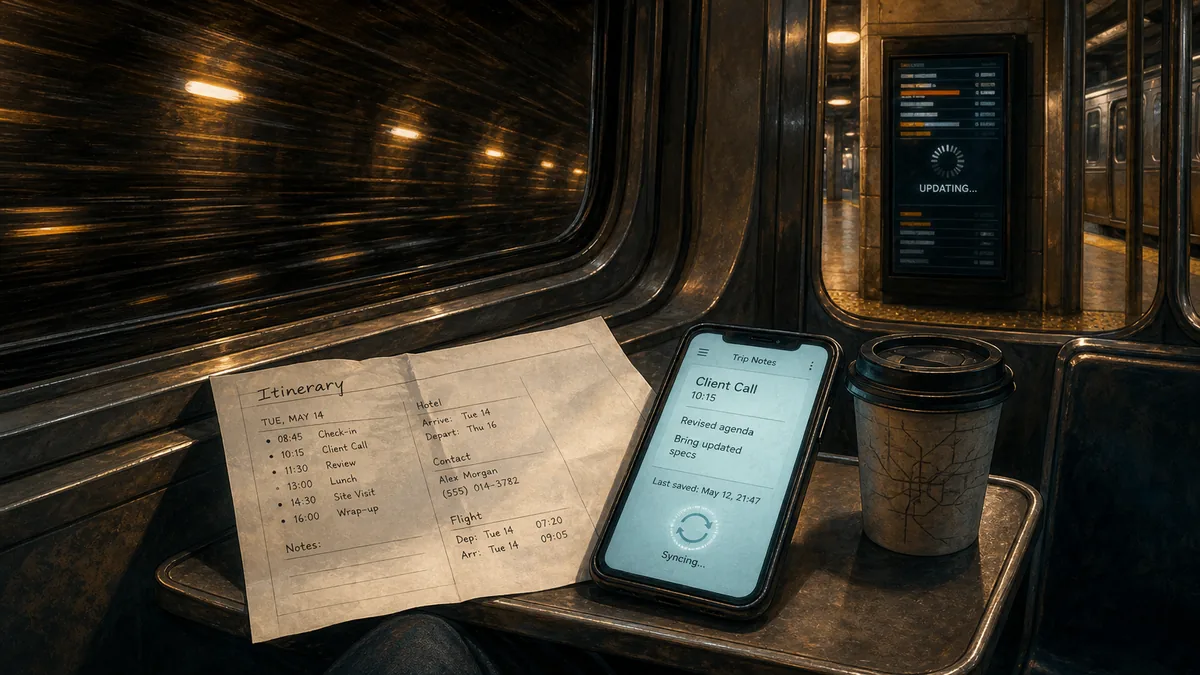

An offline-first app can appear to sync correctly and still keep the wrong version of a record. That happens when a local edit was made against an older copy, then later sent after the server copy had already changed. The real issue is not connectivity by itself. It is deciding whether the local change still fits the server state the app never saw. [f1] [f2]
Why a successful sync can still be wrong
In an offline-first setup, local data can lag behind network data, and network data can also lag behind local data until connectivity returns. That means neither side is automatically the full truth when a user edits a record. If an app only checks whether a write was delivered, it can miss that the write was based on stale data. The sync can succeed as a transport step while still producing a bad merge in the data itself. [f1] [f4]
Hypothetical example: a travel app lets someone rename a trip note on a subway ride. While the phone is offline, the server copy is updated separately to add a new gate number and revised boarding time. When the phone reconnects, the app sends the rename and the server accepts it. If that edit is merged into the same shared fields without checking freshness, the newer gate number can be overwritten even though the sync did not fail. This is the kind of stale merge that can hide inside a successful upload. [f1] [f2]
Why lazy writes create this risk
The documented lazy write pattern updates the local data source first, then queues the network notification for later. That is useful because the app can respond immediately even without connectivity. But it also creates a gap between the user action and server confirmation. During that gap, another device or process can change the server copy. When the app comes back online, the local edit may no longer be a clean update to the current record. [f2]
- Local edit happens before the network learns about it.
- The server copy can change while the app is offline.
- A later sync may complete without detecting the content mismatch.
- The app needs conflict handling, not just delivery handling.
Where conflict handling belongs in the app
The repository layer is the part meant to resolve conflicts between multiple data sources and keep the single source of truth up to date. In practice, that means the repository should not treat every incoming write as equally safe. It needs logic that can compare versions, decide whether the local change still applies, and choose a merge rule when it does not. The approved material only says that custom synchronization approaches can include custom conflict resolution algorithms, so the exact rule depends on the app. [f4] [f5] [f3]
What to watch for in product behavior
A useful way to inspect an offline app is to separate transport success from data correctness. If the interface only shows that a change was uploaded, that does not prove the right record version survived. The warning signs are subtle: a user edits one field, reconnects, and the record updates cleanly, but another field that changed elsewhere is quietly lost. That is not a connection problem. It is a conflict problem that the repository or sync layer failed to surface. [f4] [f5]
- Treat sync success as delivery, not proof of correctness.
- Check whether the edit was made against a stale local copy.
- Look for conflict resolution in the repository or sync layer.
- Keep merge decisions explicit inside the app architecture.
The practical takeaway
Offline support is not just about saving work for later. It is about preserving intent when the local and network versions diverge. If an app lets users edit offline, the real question is whether it can tell when a local change no longer fits the server record it was based on. Without that check, a sync can look healthy while quietly replacing newer data with older assumptions. [f1] [f2] [f4]
Your reaction
Loading reactions…

Comments 0
Review comments